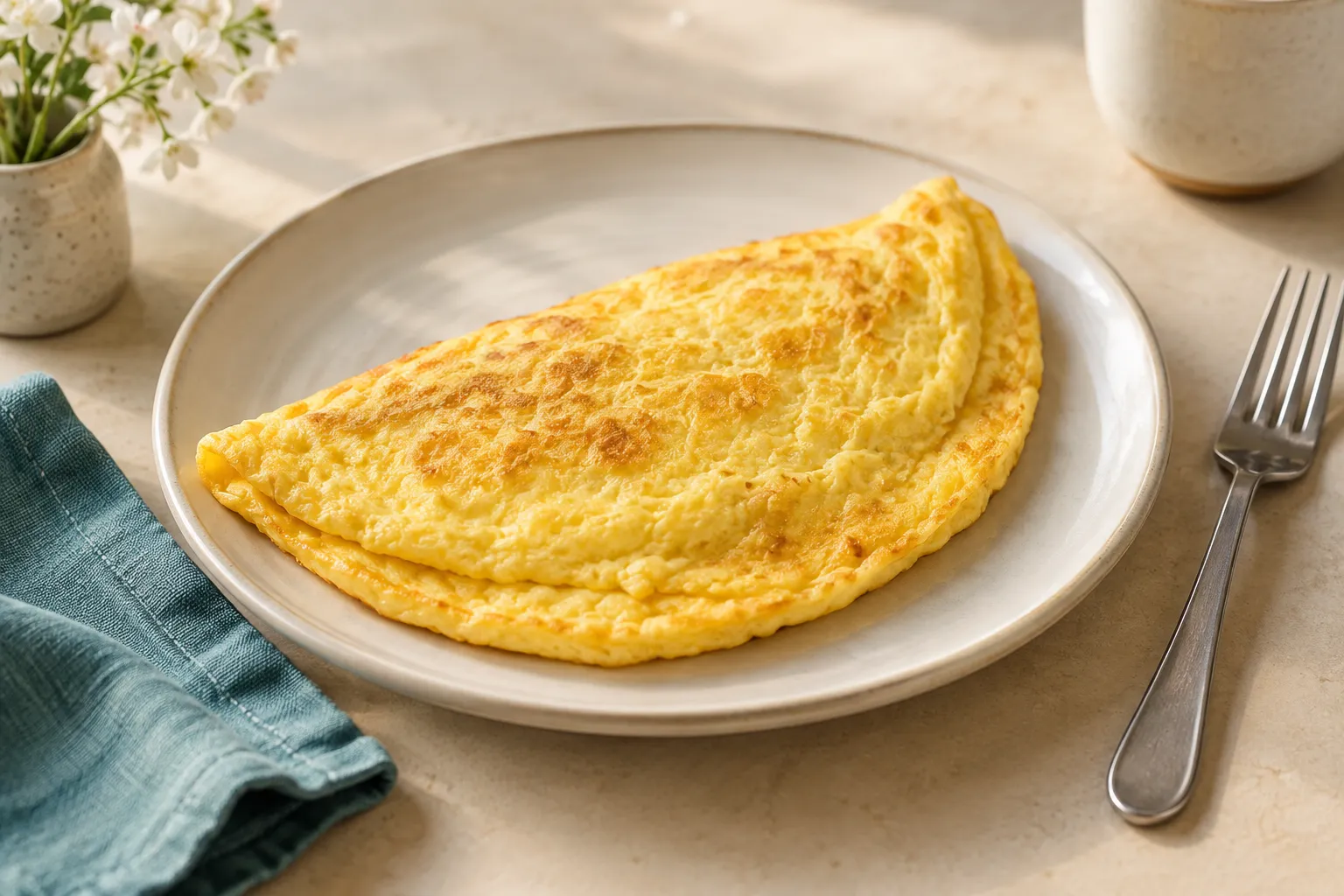
An omelet cooks quickly, so prepare the plate and filling first. A small nonstick skillet gives two eggs enough depth to fold without forming a paper-thin sheet.
Beat eggs, pour into a lightly buttered skillet and gently move set edges inward while tilting raw egg into the gaps. Once fully set, add a little prepared filling, fold and serve.
Go straight to the stepsYour project helper
Follow the steps and check them off as you go →Before you begin
Cook fillings that need cooking before they go into the eggs. Reheat leftover fillings safely. Do not taste raw egg; cook until no runny egg remains, with egg dishes reaching 160°F.
What you’ll need
- 8-inch nonstick skillet
- Bowl and fork
- Flexible spatula
- Plate
Measure before you start
Ingredients
Base batch: 1 omelet
Ingredient amounts scale; oven temperatures and cooking times do not. Split a larger batch between pans when needed. For half an egg, beat it and measure half.
Use the base batch for your first attempt. Adjust seasoning to taste and check texture as you cook.
Let’s do this
Step by step
- 01
Prepare the eggs and filling
Beat eggs with water and seasoning until the whites and yolks combine. Cut fillings small and keep the amount modest. Place everything within reach.
- 02
Warm the skillet
Melt butter over medium-low to medium heat, coating the cooking surface. The butter should foam gently rather than smoke or turn dark.
- 03
Move the setting edges
Pour in eggs. As the edges set, push them gently toward the center with a spatula and tilt the pan so uncooked egg flows into the spaces. Work around the pan without scrambling the whole mixture.
- 04
Fill and fold
When the egg is set with no liquid patches, place warm prepared filling on one half. Lift the empty half over it gently. If the egg is sticking, loosen the edge carefully before folding.
- 05
Serve promptly
Slide onto a plate and serve. If using a thermometer, check the thickest egg portion for 160°F. A clean cooked surface and manageable filling make the fold easier.
Checks stay on this page while you work and reset when you leave.
Use less filling than you think
Large hard pieces can split a thin omelet. Keep extras for the top or side of the plate rather than forcing them inside. Adjust pan heat if the underside browns before the top sets.
Serve now or store safely
Refrigerate perishable cooked food in shallow containers within 2 hours, or within 1 hour when the room or outdoor temperature is above 90°F. Keep the refrigerator at 40°F or below. Use most cooked leftovers within 3–4 days and reheat to 165°F. Do not wait for a large pot to cool completely on the counter.
A quick final check
- Prepare the eggs and filling
- Warm the skillet
- Move the setting edges
- Fill and fold
- Serve promptly
Common questions & sticking points
Why does the omelet tear?
It may be too thin, stuck, under-set or overfilled. Use a small pan and a modest prepared filling.
Can I double it?
Two separate two-egg omelets are easier to control than one large four-egg fold.
Sources & further reading Optional
References used to check this guide. Follow your product’s own safety instructions where its design differs.
Last source check: September 24, 2026