The long numbers tell only part of a measurement. Smaller marks between them supply the detail. Start with a book or box on a table so you can practice reading the scale without also balancing a long extended tape.
Read the whole inch before the endpoint, add the remaining fraction, and write the unit. On a metric scale, ten millimeters make one centimeter.
Go straight to the stepsBefore you begin
Check which scale you are using. Tapes vary in their smallest divisions. Guide a retracting metal tape back into its case rather than letting it snap toward your fingers.
What you’ll need
- A tape measure with clearly readable markings
- A flat object to measure
- Paper and pencil
Tools & supplies for this project
Affiliate disclosure: We may earn a commission when you buy through these Lowe’s links. How our links work.
Use what you already own. If you need supplies, compare these options with the requirements above and choose only the items your project needs.
Check Lowe’s for current price, availability and specifications.
Let’s do this
Step by step
- 01
Identify the scale
Find the inch markings or the centimeter markings. If both are present, choose one edge and stay with it. Count the equal spaces within one inch: a common tape has sixteen, but yours may differ.
- 02
Start from the same reference point
For an outside measurement, hook over one end of the object, pull the blade straight along it, and read directly above the far edge. The hook is the starting reference. If you deliberately start at the 1-inch mark instead, subtract that inch from the ending reading.
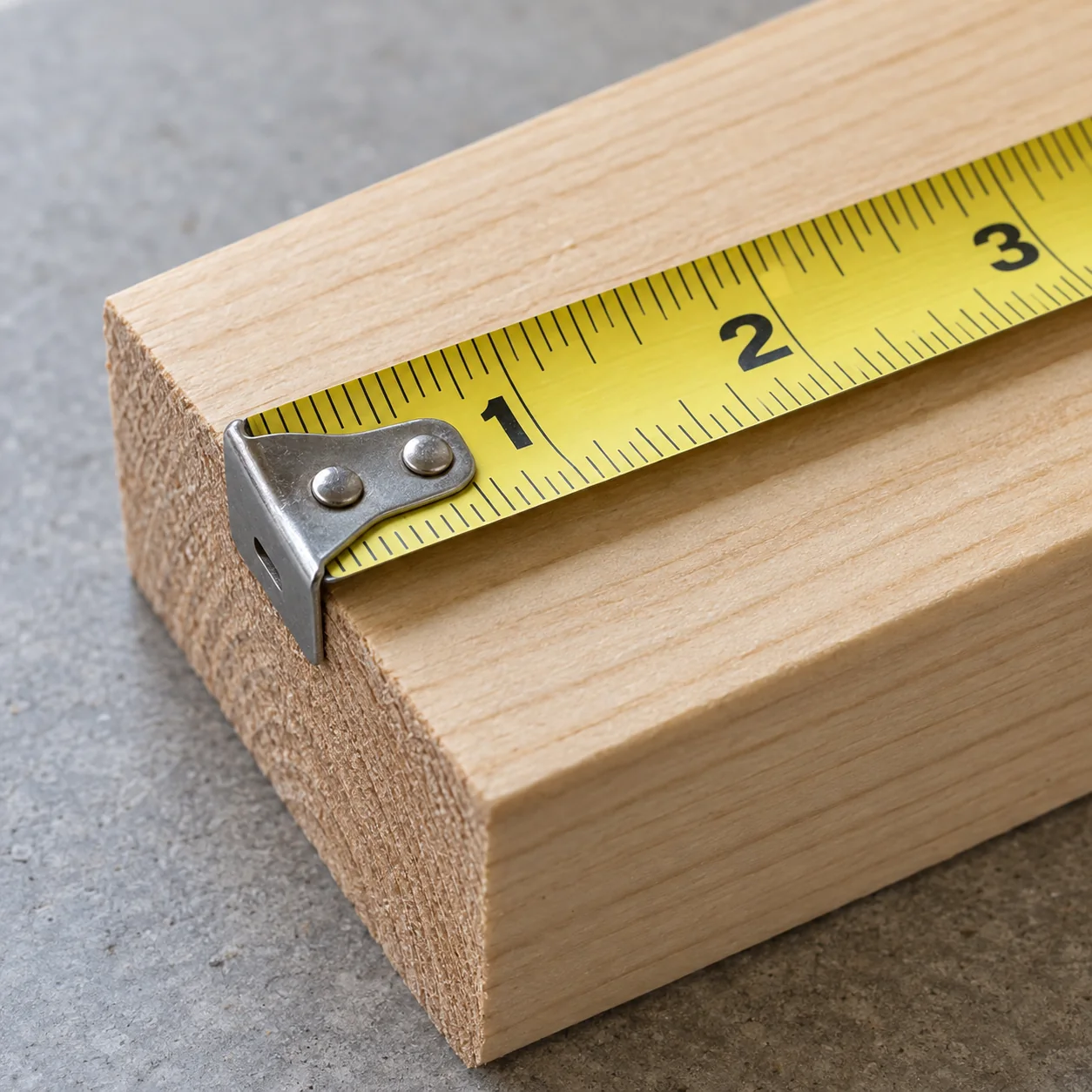
Start at the zero reference, with the hook seated against the edge. Keep the blade straight and read the mark directly above it.Open full-size image - 03
Read whole inches first
Find the last whole-inch line reached by the object. Then count the divisions after it. With sixteen equal spaces per inch, a point three spaces after 5 inches is 5 3/16 inches.

This example uses sixteenths. Count spaces after the 5-inch line; the 6-inch line is the next whole inch.Open full-size image - 04
Simplify the fraction if useful
Eight sixteenths is one half, four sixteenths is one quarter, and twelve sixteenths is three quarters. A point six spaces after 7 inches is 7 6/16, normally written 7 3/8 inches.
- 05
Try the metric side and record
Each millimeter is a small division; ten make one centimeter. An endpoint at 8 centimeters plus 4 millimeters is 84 millimeters or 8.4 centimeters. Write the value and unit immediately, then measure again.

The same distance can be written as 84 mm or 8.4 cm. Always include the unit.Open full-size image
Optional supplies on Amazon
Affiliate disclosure: As an Amazon Associate I earn from qualifying purchases. How our links work.
Use what you already have. These links open Amazon search results so you can compare suitable supplies; they are not individual product reviews.
A five-minute reading exercise
Ask someone to point at three marks on your tape, or choose three yourself and write them down before checking. Use one exact inch, one quarter-inch point, and one odd sixteenth. Say the units aloud so that an unmarked “12” does not become ambiguous later.
Next, measure the same box twice, resetting the tape between readings. If the answers differ, check the hook position, the tape’s angle, and which tick you counted. Resolve the difference before carrying that number into a cut or purchase.
Do not confuse division count with line count
Count the spaces from one whole-inch mark to the next. The endpoint line belongs to the next inch. This avoids the common off-by-one mistake when the smallest marks are closely packed.
The blade hook often moves slightly by design to accommodate inside and outside measurements. A bent hook or a damaged tape still needs checking; do not assume every loose-looking hook is accurate or broken.
When your inch is divided into sixteen equal spaces
| Spaces after the whole inch | Fraction of an inch |
|---|---|
| 1 | 1/16 |
| 2 | 1/8 |
| 4 | 1/4 |
| 6 | 3/8 |
| 8 | 1/2 |
| 10 | 5/8 |
| 12 | 3/4 |
| 14 | 7/8 |
A quick final check
- I used one scale consistently.
- I counted the divisions on this tape.
- My written measurement includes units.
Common questions & sticking points
Is 5.3 inches the same as 5 3/16 inches?
No. Decimal inches and fractional inches are different notations. Three sixteenths is 0.1875, so 5 3/16 inches is 5.1875 inches.
Should I use centimeters or millimeters?
Use the unit requested by the task and write it with the number. For example, 84 mm and 8.4 cm describe the same length. Avoid recording only “8.4” or mixing an inch measurement from one edge with millimeter marks from the other.
Sources & further reading Optional
References used to check this guide. Follow your product’s own safety instructions where its design differs.
- The Home Depot: Tape markings and measuring technique
- Johnson Level: Metric and fractional tape graduations