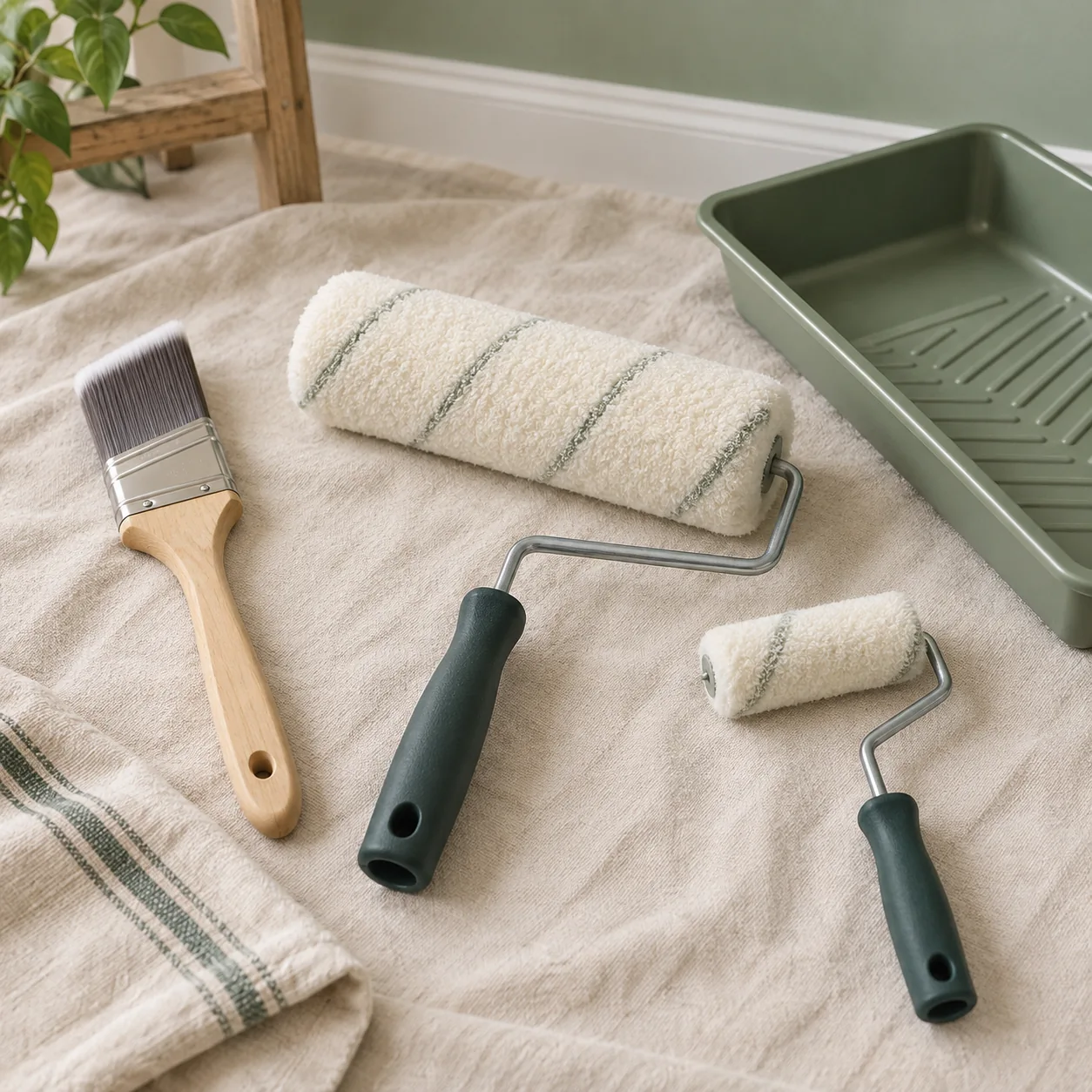
Use a brush to reach the inner corners and a small roller on the broader faces. Apply thin coats and inspect the grooves for pooled paint or runs while the coating is still workable. Bare wood or MDF needs a compatible primer first. Let coats dry according to the product instructions and remove any sanding dust before continuing; extra paint in a recess does not improve coverage.
Optional supplies on Amazon
Affiliate disclosure: As an Amazon Associate I earn from qualifying purchases. How our links work.
Choose a synthetic brush intended for water-based paint. Natural bristles absorb water and can lose their controlled shape, making the work harder. Purdy recommends synthetic filaments for latex coatings; suitable synthetic brushes may also work with oil-based products when their packaging allows it. Match the brush to both the coating and the job, rather than choosing solely by softness or the handle's size.
Optional supplies on Amazon
Affiliate disclosure: As an Amazon Associate I earn from qualifying purchases. How our links work.
Purdy UK recommends washing a new sleeve and spinning out excess water before use to improve loading and remove loose fibers. Follow the instructions for your particular sleeve and coating, especially when water would be incompatible with the paint. The goal is a clean, prepared cover, not one dripping into the tray. Check for remaining loose fibers before starting a visible wall.
Optional supplies on Amazon
Affiliate disclosure: As an Amazon Associate I earn from qualifying purchases. How our links work.
After cleaning and removing excess liquid, reshape the filaments and keep the brush in its original protective keeper. Hang it by the handle hole or lay it flat, rather than standing it on the tips. Purdy advises against prolonged soaking and tip-down storage because they can distort the filaments. Store it where other tools cannot crush the protected head before the next project.
Optional supplies on Amazon
Affiliate disclosure: As an Amazon Associate I earn from qualifying purchases. How our links work.
Some flexible prep tools use carbon steel, which can rust when left damp. Clean away residue as the tool maker directs, dry the blade thoroughly and put it away only when dry. Purdy warns against leaving these tools in water for long periods. A damp rag wrapped around the blade or a wet toolbox defeats drying, so check the storage spot too.
Purdy suggests dipping about halfway into the paint, then gently tapping the brush against the inside of the container. Avoid scooping paint up to the handle or scraping the brush nearly empty before every stroke. Start with a manageable load and reload before the brush drags dry. Excessive loading encourages drips and runs, so practice on a less conspicuous part of the project.
Optional supplies on Amazon
Affiliate disclosure: As an Amazon Associate I earn from qualifying purchases. How our links work.
Keep the tray's reservoir modestly filled; Purdy recommends no more than about one-third full. Roll the cover slowly into the paint and back across the tray several times so the entire cover absorbs paint. It should carry an even load without dripping. Reload as it starts looking dry rather than pressing harder to squeeze out the last paint, which makes consistent application harder.
Optional supplies on Amazon
Affiliate disclosure: As an Amazon Associate I earn from qualifying purchases. How our links work.
Check the calculator's assumptions before buying paint. Benjamin Moore's room calculator assumes two wall coats and excludes the ceiling, so add ceiling paint separately if that is part of the job. Record room dimensions and openings carefully, then compare the estimate with the actual product's coverage. Application method and surface conditions can change consumption, making the calculated quantity a planning estimate rather than a guarantee.
Measure each room and combine the paintable area when the same product, sheen and color will be used throughout. Keep any different ceiling or trim coating in a separate estimate. Check whether your calculator already allows for multiple coats before multiplying again. Benjamin Moore advises combining the square footage for rooms sharing a color, while treating the result as an estimate affected by application and surfaces.
It identifies a recommended gray primer shade in the Color Prime system, rather than a finish sheen or number of topcoats. Some vivid or deep colors develop more evenly over the specified gray base. Ask the paint counter to match that primer recommendation for your chosen topcoat. Do not assume any gray, or a primer tinted to the final color, will give the same result.
Conditioning leaves an even chalk-dust layer that helps later writing erase. For the cited Rust-Oleum brush-on product, wait three days after painting, rub chalk across the whole surface and erase it before normal use. Check your own can because products differ. Starting with a message on a fresh, unconditioned finish skips this preparation; a surface feeling dry does not mean its use instructions are complete.
Use the waiting time on your exact paint label. Rust-Oleum's cited brush-on chalkboard instructions call for seven days before washing with water, even though conditioning and use begin earlier. Clean gently when allowed, let the surface dry and repeat the chalk-conditioning step afterward. Do not treat touch-dry paint as washable or transfer this schedule to another chalkboard product without checking its directions.
The magnetic pigment can settle, so a poorly mixed portion may leave weak areas. Rust-Oleum directs thorough mixing before use and regular stirring during application to redistribute it. Follow the specified coverage and coat count instead of stretching a small amount across a larger wall. Apply smoothly and test your intended lightweight magnets after the required drying period before covering the area with a finish coat.
Extra coating separates the magnet from the magnetic layer. Rust-Oleum allows latex topcoats but warns that more than two heavy finish coats reduce effectiveness. Use the approved system, smooth application and the recommended amount of primer, then keep finish coats within its directions. Strong lightweight magnets generally perform better than heavy decorative ones. Test the planned combination on a sample before committing an entire wall.
Let the base paint dry completely first. When the stencil would overlap freshly painted motifs, work on alternating positions and leave a motif-sized gap between them. Annie Sloan's tile-pattern method fills those gaps after the first set dries. Lift the stencil carefully rather than sliding it across wet paint. Practice the spacing on paper so you know where each repeat belongs before starting the furniture.
Pour out a small amount of paint and roll back and forth on a suitable flat palette until the sponge carries an even spread. Start lightly rather than saturating it, and test the result on paper. Annie Sloan's method rolls across the design in both directions for coverage. Keep the stencil stable and lift carefully; do not compensate for a faint first pass with a puddle of paint.
They may be registration marks: guides that line the next repeat up with the previous one. The marks can be dots, lines or parts of the design itself. Identify them in the maker's instructions and test a repeat on paper before painting. Level the first placement carefully, then align each following position using the specified marks instead of measuring from the plastic sheet's outer edge.
Do not automatically add another layer. Annie Sloan instructs users to remove excess sitting wax with a lint-free cloth after application. Work over a small area gently and check whether surplus wax is the problem. The finish also needs time to cure, so treat it carefully during that period. Use the instructions for the exact paint-and-wax system instead of applying a generic furniture polish over it.
Annie Sloan advises avoiding aerosol polishes because their solvents or silicone may affect the wax. Routine light wiping with a damp or dry microfiber cloth is usually enough. For a stubborn mark, the maker suggests a little Clear Chalk Paint Wax on a cloth. Test discreetly and remove surplus. Use coasters and heat mats so everyday cleaning does not become repeated repair of water or heat marks.
Annie Sloan says its Chalk Paint can be applied over its own Chalk Paint Wax without removing that finish first. This is a product-system allowance, not a rule for every wax or paint. Identify the old coating and follow the current preparation directions, testing an inconspicuous area first. If the finish or wax is unknown, ask the new coating's maker before committing to the whole piece.
Check the overnight forecast and the coating's required drying conditions, not just the current air temperature. Evening cooling and dew can interfere with a fresh film even after a pleasant afternoon. Schedule the work so the surface stays dry and temperatures remain within the product's limits during its specified drying period. A low-temperature paint still has instructions to satisfy; it does not eliminate moisture concerns.
No fixed interval guarantees the wood is ready. Absorbent materials can retain moisture longer than metal or vinyl, and weather conditions affect drying. Sherwin-Williams advises waiting at least a day after heavy rain but also requires a dry surface. Check the paint's substrate-moisture requirements and postpone work if the wood remains damp. Painting over retained moisture can undermine adhesion even when the surface looks dry.
No. The coating also needs suitable conditions while its film forms. Read the product's application and drying limits and check the forecast through that period, including overnight lows and condensation. Sherwin-Williams warns that a brief warm spell during application is not enough if colder, damp conditions follow. Choose a suitable product and work window rather than trying to compensate with a heavier coat.
Do not decide from the word alkyd alone. Benjamin Moore distinguishes traditional oil-based alkyd from waterborne alkyd, which combines alkyd characteristics with soap-and-water cleanup. Read the exact can for cleanup and applicator instructions before opening a solvent. Clean tools promptly using that method. The formulation also has its own drying and recoating schedule, so do not substitute the instructions from an older oil-paint project.