The first draw changes what remains available. If a bag contains three blue and two red counters, the chance of two blue draws without replacement is (3/5) × (2/4) = 3/10. Both the blue count and total count fall after the first blue draw. Using 3/5 twice would wrongly treat the second draw as unchanged.
Find the lower quartile Q1 and upper quartile Q3 using the method required by your course or software, then subtract Q1 from Q3. If they are 12 and 27, the interquartile range is 15. It describes the spread of the middle half of the data. Quartile conventions can differ, so keep the same method when comparing results.
A percentile describes position within a reference group, not the percentage of questions answered correctly. The 80th percentile means a value is around the point below which 80 percent of that group falls. Ties and calculation methods can change the exact interpretation. Always identify the comparison group before interpreting a percentile, especially when two reports use different populations.
The box runs from the first quartile to the third quartile, with a line marking the median. Its length shows the interquartile range rather than the entire data range. Read the axis scale before comparing two boxes. Whisker conventions vary: some extend to extremes while others stop before separately marked outliers, so check the chart’s definition.
Calculate IQR = Q3 − Q1, then form the lower fence Q1 − 1.5 × IQR and upper fence Q3 + 1.5 × IQR. With Q1 = 10 and Q3 = 18, the fences are −2 and 30. Values outside them deserve examination. A flagged value is not automatically an error and should not be deleted without context.
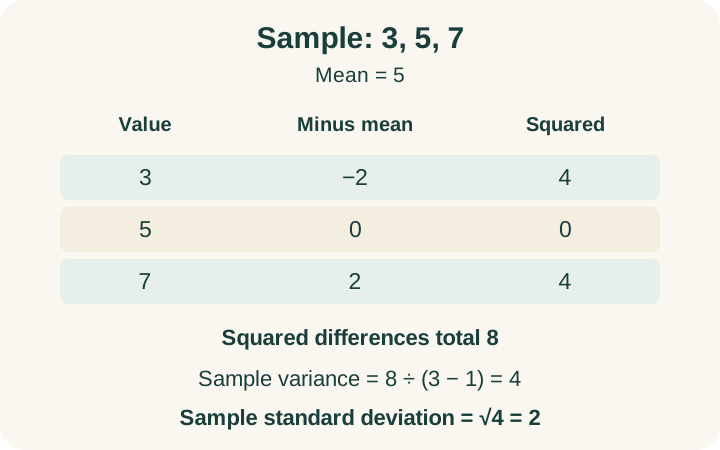
Find the mean, subtract it from each observation, square those differences, and add the squares. Divide by one less than the number of observations. For the sample 3, 5, 7, the mean is 5 and the squared differences total 8, so sample variance is 8/2 = 4. Population variance uses a different denominator; state which you calculated.
Calculate the sample variance and take its square root. For observations 3, 5, and 7, the mean is 5, the squared differences sum to 8, and dividing by 3 − 1 gives variance 4. The standard deviation is therefore 2. Its units match the original data; variance has squared units. Keep intermediate precision until the final answer.
Subtract the mean from the observed value and divide by the standard deviation. If the mean is 60, the standard deviation is 8, and your value is 76, then z = (76 − 60)/8 = 2. The value is two standard deviations above the mean. A negative result lies below it. A zero standard deviation makes this calculation undefined.
Multiply the z-score by the standard deviation, then add the mean: value = mean + z × standard deviation. With mean 60, standard deviation 8, and z = −1.5, the value is 48. Check the direction: a negative z-score should place the result below the mean. Use the mean and spread from the same reference distribution.
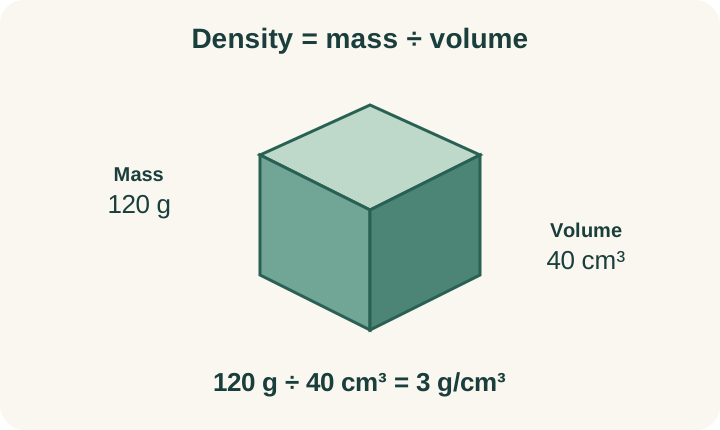
Divide mass by volume and keep the resulting units. A sample with mass 120 grams and volume 40 cubic centimeters has density 3 g/cm³. Do not use weight in newtons as though it were mass in grams. If your measurements use different unit systems, convert them first so the final density has the units you intended.
Multiply by 1,000. One gram is 0.001 kilogram, while one cubic centimeter is 0.000001 cubic meter, so their ratio produces that factor. Thus 2.7 g/cm³ equals 2,700 kg/m³. Convert both the mass and the volume units; changing grams to kilograms alone would give an answer a million times away from the correct scale.
Subtract initial velocity from final velocity and divide by the elapsed time. If velocity changes from 4 m/s to 16 m/s in six seconds, average acceleration is (16 − 4)/6 = 2 m/s². Use a consistent positive direction and include signs for velocity. This describes the average over that interval, even if acceleration varied within it.
No. The sign tells you the direction of acceleration relative to your chosen positive direction. If velocity and acceleration have opposite signs, speed decreases; if their signs match, speed increases. An object moving in the negative direction with negative acceleration is speeding up. Decide the coordinate direction first, then compare the signs instead of treating negative as a synonym for slower.
Average velocity uses displacement, which includes direction; average speed uses total distance traveled. If you walk 100 meters out and 100 meters back in 200 seconds, total distance is 200 meters but displacement is zero. Your average speed is 1 m/s and average velocity is zero. Neither calculation describes every moment of the trip separately.
Divide distance by speed, using compatible units. Traveling 150 kilometers at a constant 60 kilometers per hour takes 150/60 = 2.5 hours, or two hours thirty minutes. This ideal calculation excludes stops and changing speed. For a real journey, add planned stops and recognize that posted speed limits are not a prediction of your actual average speed.
Keep the base and add the exponents. For example, x³ × x⁴ = x⁷ because the product contains seven factors of x. This rule applies to multiplication of like bases, not addition: x³ + x⁴ cannot be shortened to x⁷. If the bases differ, first check whether they can be rewritten using a common base; do not combine the exponents automatically.
Multiply the exponents: (x³)⁴ = x¹². The outside exponent tells you to multiply four copies of x³. If there is a coefficient inside the brackets, raise that too: (2x³)⁴ = 16x¹². Keep the parentheses visible until you have applied the outside power to every factor; simply writing 2x¹² would leave part of the expression unchanged.
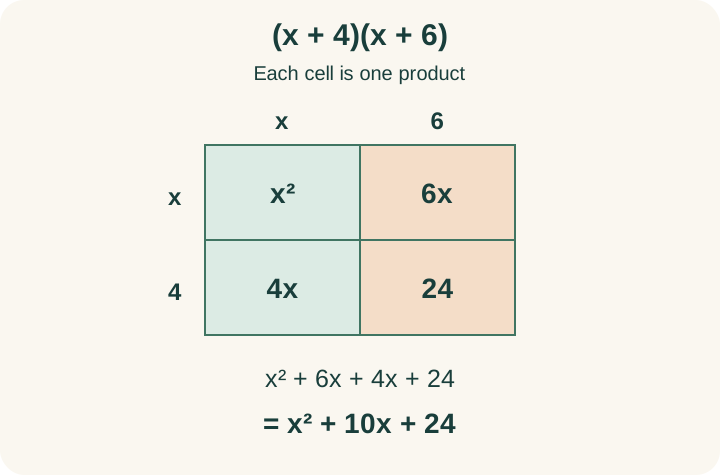
Multiply every term in the first bracket by every term in the second, then combine like terms. For (x + 4)(x + 6), the products are x², 6x, 4x, and 24. Together they give x² + 10x + 24. A small multiplication grid can keep the four products visible. Check each sign before combining the middle terms.
Multiply the outside term by each term inside, keeping their signs. For −3x(2x − 5), calculate −3x × 2x = −6x² and −3x × (−5) = 15x. The result is −6x² + 15x. The second product is positive because both factors are negative. Distributing only to the first term changes the value of the original expression.
Squaring a bracket means multiplying it by another identical bracket. Thus (x + 5)² = (x + 5)(x + 5) = x² + 10x + 25. The middle term comes from the two cross-products, 5x and 5x. As a quick check, use x = 1: the original gives 36, while the incorrect x² + 25 gives only 26.
For (a + b)(a − b), the middle products cancel and the result is a² − b². For example, (x + 7)(x − 7) = x² − 49 because −7x and +7x add to zero. The brackets must have the same two terms with opposite signs between them. If the numbers differ, expand normally rather than assuming cancellation.
Divide the coefficients, then subtract the denominator’s exponent from the numerator’s for each matching nonzero base. For 18x⁵ divided by 6x², the coefficient is 3 and the remaining power is x³, so the result is 3x³ for x ≠ 0. You can check by multiplying 3x³ by 6x² to recover 18x⁵. Keep any original restrictions.
Compare two ways to write a number divided by itself. For example, 7³/7³ is 1, while the exponent rule writes it as 7³⁻³ = 7⁰. Therefore 7⁰ = 1. The same reasoning works for any nonzero base. The nonzero condition matters: division by zero is undefined, so this argument does not establish a value for 0⁰.
Divide every term in the numerator by the denominator. For (12x³ + 8x² − 4x)/(4x), the three quotients are 3x², 2x, and −1, giving 3x² + 2x − 1 for x ≠ 0. Do not divide only the first term. Multiply the simplified polynomial by 4x to check that all three original terms return.