Substitute the proposed number into the original equation and evaluate both sides independently. For y − 8 = 15, testing y = 23 gives 23 − 8 = 15, which is true. Testing 22 gives 14 = 15, which is false. Use the original version so an earlier rewriting mistake cannot make an incorrect answer appear valid.
Add the ratio’s parts, divide the total by that sum, then multiply by each part. To divide 84 counters in a 2:5 ratio, there are seven parts worth 12 counters each. The groups contain 24 and 60. Check both their sum and their ratio. Dividing 84 by 2 and by 5 separately does not split the total correctly.
Divide the desired length by the existing length and multiply by 100. To enlarge a 12 cm feature to 18 cm, use 18 ÷ 12 × 100 = 150 percent. That is the final scale setting, not a 150 percent increase. Check a printed test measurement because print margins or fit-to-page settings can change the physical result.
Divide the required quantity by the rate, with compatible units. At a steady 18 labels per minute, producing 270 labels takes 270 ÷ 18 = 15 minutes. This is the running time only. If setup, pauses or reloading also take time, add those separately rather than assuming the machine works continuously at the stated rate.
Convert both rates to the same time unit before comparing them. A rate of 7 items per minute equals 420 items per hour because an hour contains 60 minutes. It is faster than 390 items per hour under the same conditions. Check that both measurements count the same kind of completed item and include comparable pauses or operating time.
Multiply each value by its weight, add the products, and divide by the total weight. Scores of 70 and 90 with weights 1 and 3 give (70 + 270) ÷ 4 = 85. If weights already sum to one, simply add the weighted products. Check that you use the intended weights rather than treating every value equally.
Only when their groups carry equal weight. A group of two with mean 10 and a group of eight with mean 20 have combined mean (2 × 10 + 8 × 20) ÷ 10 = 18. Averaging 10 and 20 gives 15 and ignores the different group sizes. Recover each group total first, then divide by the combined count.
Look for pairs of whole numbers whose product is the number. For 30, the pairs are 1 and 30, 2 and 15, 3 and 10, and 5 and 6. Stop once you would repeat pairs in reverse. Collect both members of each pair, giving 1, 2, 3, 5, 6, 10, 15, and 30.
A prime is a whole number greater than one with only two positive factors: one and itself. Test possible prime divisors up to the number’s square root. For 47, test 2, 3, and 5; none divides it evenly, and the next prime is already above its square root. Therefore 47 is prime. One is neither prime nor composite.
Repeatedly divide by a prime that goes in evenly until only primes remain. For 84, divide by 2 to get 42, by 2 again to get 21, then split 21 into 3 and 7. Thus 84 = 2 × 2 × 3 × 7. Multiply the factors back together to check that none was lost.
Write each number as prime factors, then take the greatest number of copies of every prime needed by either number. For 18 = 2 × 3² and 24 = 2³ × 3, use 2³ × 3² = 72. Check that both original numbers divide 72 evenly. The least common multiple is a shared multiple, not necessarily their product.
Move the decimal point until the first factor is at least one but less than ten, then use a negative power of ten to preserve the value. For 0.00072, moving four places gives 7.2 × 10⁻⁴. The negative exponent means division by a power of ten. Expand your result once to check the number of leading zeros.
Multiply the first factor by the stated power of ten. A positive exponent moves the decimal right; a negative exponent moves it left. For example, 6.3 × 10⁴ becomes 63,000, while 6.3 × 10⁻⁴ becomes 0.00063. Count the places carefully and insert zeros as needed. The exponent changes the scale, not the digits in the first factor.
Rearrange the equation into y = mx + b. The coefficient m is the slope and b is the y-intercept. For y = 3x − 4, the slope is 3 and the line crosses the vertical axis at (0, −4). Keep the sign attached to each number. If y is not isolated, finish rearranging before identifying the two values.
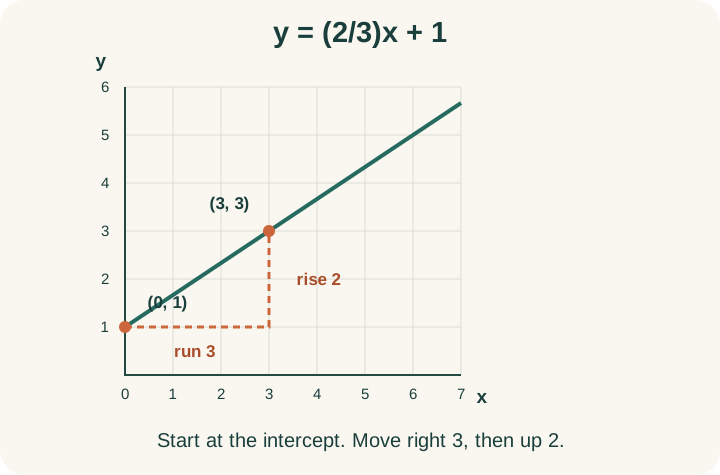
Plot the y-intercept first, then use slope as vertical change divided by horizontal change. For y = (2/3)x + 1, start at (0, 1), move right three and up two, and mark (3, 3). Draw the straight line through those points. Check another point in the equation and keep the scales on both axes clearly labeled.
Subtract the y-values and divide by the change in x, keeping the points in the same order in both subtractions. From (2, 3) to (6, 11), slope is (11 − 3)/(6 − 2) = 2. That means y increases two units for each one-unit increase in x. A zero x-change needs special treatment because division by zero is undefined.
A vertical line changes y while x stays fixed, so the slope calculation would divide by zero. That has no defined numerical result. A horizontal line is different: y does not change while x can, giving slope zero. For example, x = 5 is vertical and y = 5 is horizontal. Do not swap those two special cases.
Isolate one variable in one equation, then replace that variable in the other equation with the expression you found. With y = x + 3 and x + y = 11, substitute to get x + x + 3 = 11. Thus x = 4 and y = 7. Check the pair in both original equations before calling it a solution.
A contradiction can mean the system has no solution, provided the algebra was correct. For y = 2x + 1 and y = 2x + 5, equating the right sides gives 1 = 5 after subtracting 2x. No value of x makes that true. These lines have the same slope and different intercepts, so they never meet.
Arrange like variables in matching columns, then add or subtract the equations so one variable cancels. For x + y = 9 and x − y = 3, adding gives 2x = 12, so x = 6. Substitute into either original equation to get y = 3. If coefficients do not cancel immediately, multiply entire equations first.
If one equation is simply a multiple of the other, elimination removes every variable and leaves a true identity. For x + y = 7 and 2x + 2y = 14, subtracting twice the first equation gives 0 = 0. The equations describe the same line, so infinitely many pairs work. It does not mean every possible pair is valid.
Multiply their probabilities when the events are independent. The chance of rolling a six on a fair die and getting heads on a separate fair coin is (1/6) × (1/2) = 1/12. Independence matters: one result must not change the probability of the other. If the events affect each other, use the appropriate conditional probability instead.
Add the two probabilities and subtract their overlap so it is not counted twice. On a fair die, being even has probability 3/6 and being greater than four has probability 2/6. Six belongs to both groups, so the result is 3/6 + 2/6 − 1/6 = 4/6. This includes outcomes satisfying either condition or both.
Draw a branch for each first outcome, then branches for the second outcomes from each of those. Write the relevant probability on every branch. Multiply along a complete path to find that sequence’s probability; add different paths when they meet the same target. At each branching point, the probabilities of all possible next outcomes should add to one.