The name describes the rice variety and its sticky behavior, not added sugar. Bob’s Red Mill’s product contains sweet white rice alone, with a neutral flavor, and is used for foods such as mochi and as a binding ingredient in baking blends. Buy the type your recipe names rather than choosing it as a sweetener. Its useful sticky texture is a reason to use a formula developed for sweet rice flour instead of improvising an entire cake with it.
Use it for a delicate cake you want to serve upright without turning it upside down, such as cheesecake or a cake with a loose streusel topping. The side wall unlocks and lifts away from its separate base. Before buying or filling one, check that the base fits securely and the latch closes tightly; some springform pans leak. Match the recipe’s size and pan type rather than assuming any thin cake batter belongs in a springform.
Usually not without changing the quantity. Tart pans are often about an inch deep, while a typical pie pan is deeper and a deep-dish pie pan deeper still. A removable tart-pan bottom helps release the crust for serving, but it does not increase capacity. Compare the actual inside dimensions and depth, not only the named diameter. Use a tart recipe or adjust the filling deliberately rather than forcing the full pie quantity into a shallow pan.
A rigid bench scraper can divide dough into portions, lift and move pieces, and gather dough from a flat work surface. OXO also describes using its model for cutting brownies and lifting cookies. A broad blade is especially convenient for keeping portions together while moving them. Use it on a surface suitable for its edge, and choose a flexible bowl scraper instead when the task is following the curve of a mixing bowl.
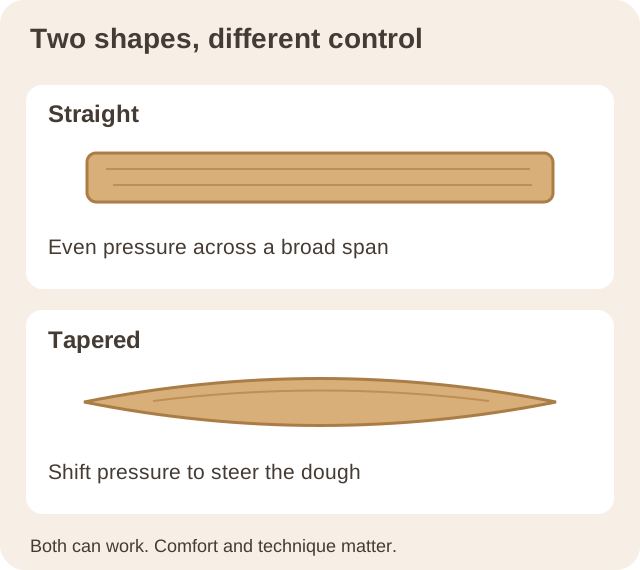
A straight pin applies even pressure over a wide span, which is convenient for large rectangles of pastry or cookie dough. A tapered French pin lets you shift pressure toward either end and swivel more easily, useful for steering pie dough into a circle. King Arthur’s comparison found both usable for several tasks, so comfort matters more than owning every style. Thickness-guide rings or a fixed-depth pin help with uniform cookies, but can limit the width or thickness you can roll.
No. If you will use one tip for the whole bag, you can fit that tip directly into the bag. A coupler is useful when you want to exchange tips while keeping the same frosting inside: its base sits inside the bag and its outer ring secures the tip. Choose a coupler sized for the tips you intend to use. Wilton notes that not all tips are designed for couplers, so check their fit before filling the bag.
Wash the tips in warm soapy water and use a small tip-cleaning brush to reach the narrow openings and grooves. Rinse thoroughly, then let them dry completely before putting them away. Wilton says its stainless steel tips can also go on the dishwasher’s top rack; follow the care directions for your own tips. Store them with the narrow ends upward in an organizer so the delicate openings are less likely to be knocked out of shape.
Use a sturdy serrated bread knife on a stable cutting board. King Arthur’s comparison found that the serrations gripped chocolate more effectively than several other tools. For a thin bar or wafers, use controlled rocking cuts with your hand on the handle, keeping fingers clear of the blade. Very thick blocks need a different approach rather than forcing that rocking motion. Chopping also lets you choose a mixture of fine flecks and larger pieces for your recipe.
Chopped chocolate creates a range of pieces, from fine flecks to larger melting pockets, while chips make more uniform bites and often hold their shape better. A bar also lets you choose the chocolate’s sweetness and cocoa percentage. Those differences can change the cookie’s texture, so follow the recipe when reproducing a particular result. If you substitute, expect a different distribution of chocolate rather than treating the two forms as visually interchangeable.
Sally McKenney explains that air from the eggs can rise to the surface and form a pale bubbly film. Some batches develop it and others do not. Mix the filling until combined rather than whipping in unnecessary air, and follow the recipe’s doneness cues. A light bubbly surface alone need not mean the filling failed. Once the bars are properly baked and chilled, the usual dusting of confectioners’ sugar covers that cosmetic layer.
Follow the recipe: Sally’s lemon bars call for pouring filling onto a warm prebaked crust. Her method lightly pricks the baked surface without piercing all the way through, helping the filling adhere and the crust stay in place. Prepare the filling while the crust bakes so the two stages connect smoothly. Do not apply the cooling instructions for a filled tart to this different method; letting this crust cool for too long can contribute to separation.
It contributes the characteristic tang and works with the baking soda in the recipe’s leavening system. That is part of what distinguishes these cookies from an ordinary cinnamon-coated sugar cookie. Sally’s recipe offers a baking-powder alternative, but notes that the flavor will differ. Use the substitution specified for your particular formula rather than omitting the cream of tartar while leaving everything else unchanged, because the soda and acidic ingredient were chosen to work together.
The rest softens the oats before they enter the dough, helping produce a tender, moist cookie rather than a drier, more distinct oat texture. King Arthur’s version heats its measured milk and butter, stirs in the oats, and waits about five minutes until the liquid is absorbed and the mixture has cooled slightly. Use that recipe’s complete balance of ingredients; adding an extra oat soak to another cookie formula would also add unaccounted-for liquid and fat.
Metal transfers heat quickly and evenly, making aluminum a useful choice for bottom-crust browning. Glass warms more slowly but lets you see the underside, which helps judge whether a fruit pie needs longer. Ceramic performance varies with thickness and construction and generally heats more slowly than metal. King Arthur’s comparison produced successful pies in all three, with the most even browning in metal. Match the recipe’s dimensions and assess doneness rather than expecting pan material alone to fix a wet crust.
Do not treat them as equal substitutes. Odense’s almond paste has a higher proportion of almonds, while its marzipan contains more sugar and is intended especially for candy making. Swapping them changes both the sweetness and the almond contribution to a dough or filling. Buy the ingredient the recipe names, or choose a formula developed for the one you have. A marzipan decoration or center is a different use from almond paste blended throughout a batter.
For ordinary recipe quantities, King Arthur recommends substituting vanilla bean paste for extract in the same measured amount. Paste is a syrupy, sweetened product containing visible vanilla seeds, so it is especially useful when you want those flecks in a pale custard or frosting. Extract gives flavor without that appearance. Paste is not unsweetened, although a teaspoon usually contributes little sugar to an entire recipe. Check your product’s directions if it has a different concentration.
Start much smaller because extracts differ greatly in strength. King Arthur’s bakers suggest beginning with roughly one-quarter as much when experimenting with a different flavor; almond and lemon can be especially forceful. Use a recipe developed for the extract when you want a predictable result. For experimentation, a small portion of finished frosting lets you assess the flavor before changing the entire batch. Record the quantity so you can adjust a future batch deliberately.
Bob’s Red Mill suggests combining equal parts of its ordinary whole-wheat flour and all-purpose flour for a lighter alternative. This changes the blend’s whole-grain proportion, so it is a practical approximation rather than the identical ingredient. The company also suggests combining whole-wheat and cake flour in equal parts. Choose one approach and keep the recipe’s total flour quantity consistent; replacing the entire amount with a stronger whole-wheat flour may produce a less tender result.
King Arthur discusses returning softened butter to the fridge, but very soft or partly melted butter may no longer behave the same in the intended recipe. Follow storage directions and avoid using questionable butter.