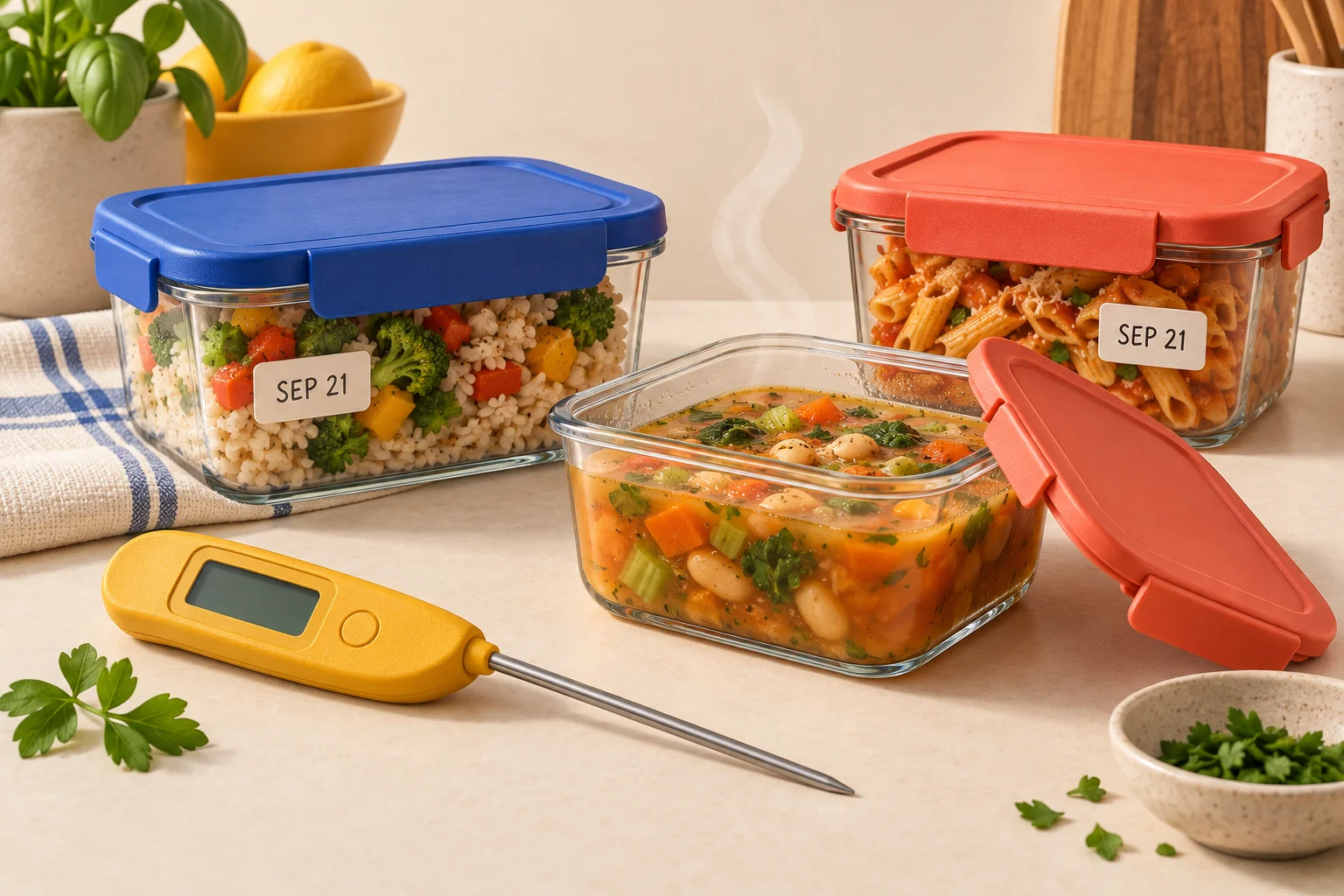
Good leftover storage begins when the meal ends. Small containers, clear dates, and a thermometer make the next meal easier to judge. The rules below apply to ordinary perishable cooked leftovers; individual products and specialized preparations may have more specific instructions.
Refrigerate promptly in shallow containers, use refrigerated leftovers within 3–4 days, and reheat to 165°F (74°C).
Go straight to the stepsBefore you begin
Discard perishable food left out over two hours, or over one hour when above 90°F (32°C). Reheating does not make improperly stored food reliably safe.
What you’ll need
- Shallow food-storage containers
- A refrigerator at 40°F (4°C) or below
- Labels or tape
- A food thermometer
Tools & supplies for this project
Affiliate disclosure: We may earn a commission when you buy through these Lowe’s links. How our links work.
Use what you already own. If you need supplies, compare these options with the requirements above and choose only the items your project needs.
Check Lowe’s for current price, availability and specifications.
Let’s do this
Step by step
- 01
Check the time
Put perishable leftovers away within the safe time window. Do not wait for a large pot to become completely cool on the counter.
- 02
Divide into small portions
Transfer food into shallow containers so it cools faster. Hot food can go directly into the refrigerator.
- 03
Date and refrigerate
Mark the storage date. Keep the refrigerator at 40°F (4°C) or below.
- 04
Use or freeze
Eat refrigerated leftovers within 3–4 days. Freeze sooner if you will not use them within that period.
- 05
Check the reheating temperature
Heat leftovers to 165°F (74°C), using a food thermometer to check the center and other spots. Follow food-specific reheating directions.
Optional supplies on Amazon
Affiliate disclosure: As an Amazon Associate I earn from qualifying purchases. How our links work.
Use what you already have. These links open Amazon search results so you can compare suitable supplies; they are not individual product reviews.
Build a simple leftover system
Keep a small roll of tape and a pen beside your storage containers. Write the food name and the date cooked before putting the container away. A label such as “chicken stew — Monday” is easier to act on than a row of identical unmarked boxes. Add a reminder to use or freeze it within the safe window.
Portion according to how you expect to eat the food. A single lunch portion is easier to take out than a large container that gets opened for every meal. Put older containers somewhere visible so a new batch does not hide them. Do not mix a fresh batch into an older one and restart the date.
Check the food, not just the appliance timer
Different amounts and shapes of food heat differently. Use the thermometer to check more than one place, including the middle of a dense portion. Follow the thermometer’s instructions for inserting the probe and cleaning it. A hot container or a little visible steam does not establish the temperature throughout the food.
If you do not know how long a perishable meal has been warm, guessing is not a reliable way to clear it for lunch. Use a brief written record when cooking for several days: when it was cooked, when it was put away, and whether it was refrigerated or frozen. The useful habit is making that information easy to find.
A quick final check
- The food was put away within the safe time window.
- Its cooking date and storage method are known.
- Reheated leftovers reached the recommended internal temperature.
Common questions & sticking points
It smells fine. Is it safe?
Smell is not a reliable safety test. Use the storage time and temperature limits.
Does this apply to rice?
Yes. Cooked rice also needs prompt refrigeration; do not leave it out overnight.
Sources & further reading Optional
References used to check this guide. Follow your product’s own safety instructions where its design differs.
- FoodSafety.gov: Storage times and reheating leftovers
- FoodSafety.gov: Safe minimum internal temperatures
- FoodSafety.gov: Rice and foodborne bacteria