Hard-boiled eggs are useful for salads, sandwiches, and prepared lunches. For a first batch, keep the egg size and cooking method consistent. The method below brings cold water to a boil, then cooks the eggs in the covered pan off the burner; it is not a twelve-minute rolling boil.
Cover large eggs with an inch of cold water. Bring just to a boil, remove the pan from the burner, cover, and leave for about 12 minutes. Cool immediately in ice water.
Go straight to the stepsBefore you begin
Use a pan that holds the eggs in a single layer. FDA guidance is to cook both whites and yolks until firm. The timing below is for large eggs and is a guide, not a substitute for checking your result.
What you’ll need
- Large, refrigerated eggs with intact shells
- A saucepan with a lid
- Water and a timer
- A bowl of ice water
- A slotted spoon
Let’s do this
Step by step
- 01
Arrange the eggs and add water
Place the eggs in one layer and add cold water to about an inch above them. Keep the pan handle in a safe position. Set the ice-water bowl nearby before heating so you are ready for the cooling step.
- 02
Bring the water just to a boil
Heat the pan over high heat until the water reaches a boil. Remove it from the burner and cover it. Start the timer at this point; do not include the initial water-heating time in the twelve-minute standing period.
- 03
Leave the covered pan off the heat
Allow about 12 minutes for large eggs. The American Egg Board’s version gives about 9 minutes for medium eggs and 15 for extra-large eggs. Keep track of the size you used rather than mixing timings from different methods.
- 04
Cool the eggs immediately
Carefully transfer them into the ice water and let them cool enough to handle. Keep hot water away from your hands. Peel an egg and check that both the white and yolk are firm before treating the batch as ready to eat.
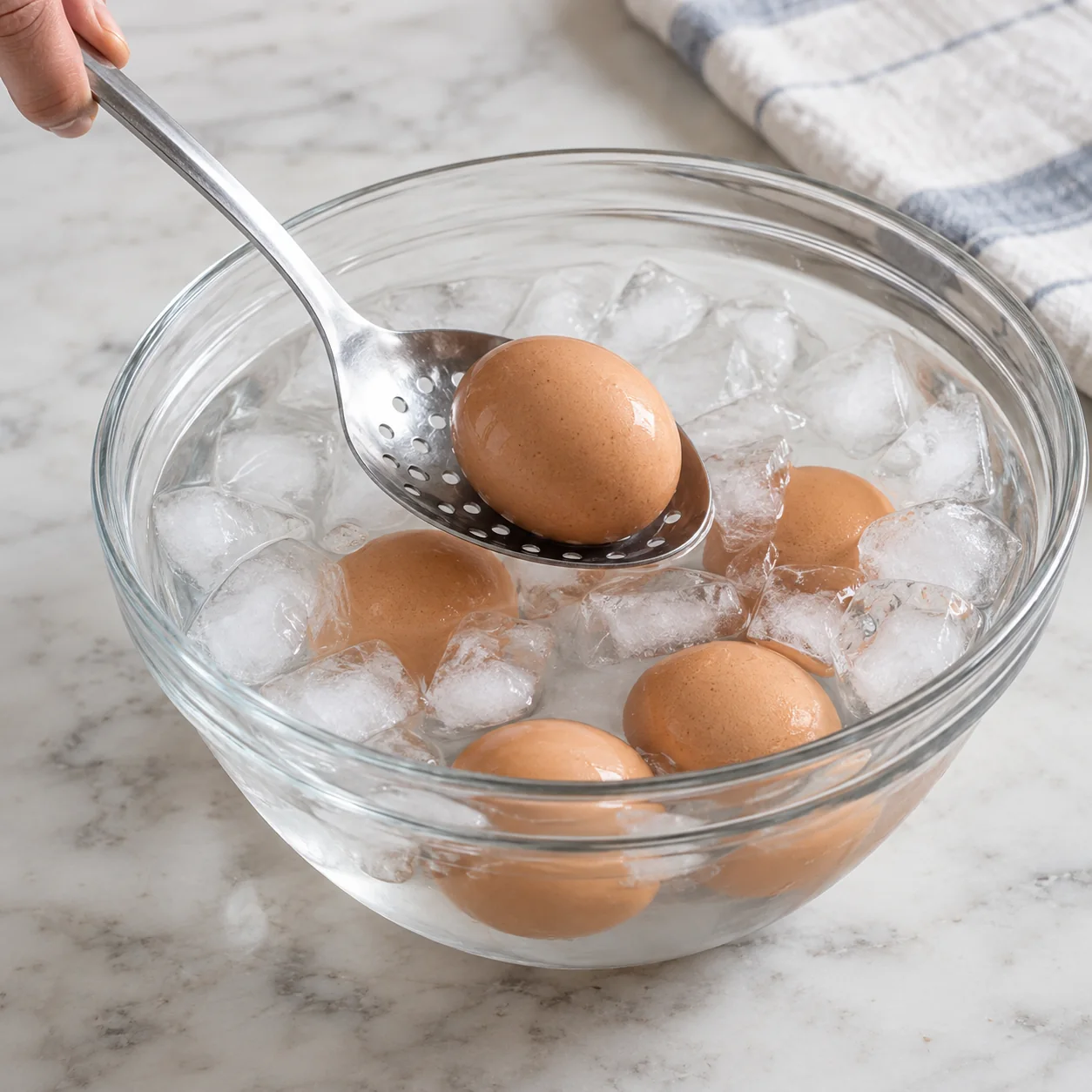
Transfer the eggs carefully with a suitable utensil. Keep the hot water away from your hands as you move them to cool.Open full-size image - 05
Peel what you need and label the rest
Gently crack the cooled shell and remove the shell and membrane. Check for fragments. Refrigerate the eggs promptly, label the cooking date, and use hard-cooked eggs within one week whether peeled or still in the shell.
Optional supplies on Amazon
Affiliate disclosure: As an Amazon Associate I earn from qualifying purchases. How our links work.
Use what you already have. These links open Amazon search results so you can compare suitable supplies; they are not individual product reviews.
Make your first batch a useful reference
Write down the egg size, the number of eggs, and the time used. A note such as “six large eggs, single layer, twelve minutes off heat” helps you repeat the same process. If the result is not fully set, do not label it hard-boiled or use it as your reference batch.
Prepare only what you expect to use. For example, four eggs may be enough for two lunches without filling the refrigerator with an unplanned batch. Store the cooked eggs separately from raw ones so you do not have to guess which carton contains which.
Keep prepared lunches cold
Do not leave cooked eggs sitting on the counter for the rest of the morning. FDA guidance limits time outside refrigeration to two hours, or one hour above 90°F. A lunch containing eggs also needs appropriate cold storage; the one-week refrigerator guideline does not mean a week at room temperature.
A quick final check
- Both the white and yolk are firm.
- The eggs were cooled and refrigerated promptly.
- The cooking date is clearly marked.
Common questions & sticking points
Why is the shell difficult to peel?
Very fresh eggs can be harder to peel. Work gently after cooling rather than tearing away large pieces of white; perfect appearance is less important than proper cooking and storage.
Does peeling change the one-week limit?
No. FDA’s one-week recommendation applies to refrigerated hard-cooked eggs both peeled and in the shell.
Sources & further reading Optional
References used to check this guide. Follow your product’s own safety instructions where its design differs.
- American Egg Board: Hard-boiled method and peeling demonstration
- American Egg Board: Covered-pan hard-boiled method in recipe notes
- FDA: Firm yolks and whites, refrigeration, and storage limits