They may contain the same radical once perfect-square factors are removed. For √72 + √32, rewrite the terms as 6√2 and 4√2, then add them to get 10√2. Simplify each term independently before comparing. The original expression is not √104: taking the square root of a sum is generally different from adding two square roots.
For nonnegative real numbers, multiply the radicands and simplify the result. For √6 × √15, write √90 = 3√10. If coefficients are present, multiply those separately: 2√6 × 5√15 = 30√10. The nonnegative condition keeps the rule within real square roots; do not apply it blindly to negative radicands without considering complex numbers.
Distribute each term as you would with algebraic brackets, then simplify radicals and combine like terms. For (√3 + 2)(√3 + 5), the products are 3, 5√3, 2√3, and 10, giving 13 + 7√3. Remember that √3 × √3 = 3. Keeping all four products visible helps prevent losing a middle term.
Multiply the numerator and denominator by that same square root. For 5/√11, multiply by √11/√11 to get 5√11/11. This changes the form but not the value because you multiplied by one. Simplify the result if it has any common factors. A denominator must remain nonzero throughout the calculation.
Multiply top and bottom by the denominator’s conjugate, which changes the sign between its terms. For 1/(4 + √7), use (4 − √7)/(4 − √7). The denominator becomes 16 − 7 = 9, so the result is (4 − √7)/9. Multiply the entire numerator as well; changing only the denominator changes the fraction’s value.
Isolate the square root, square both sides, solve the resulting equation, then check the original. For √(x + 6) = 5, squaring gives x + 6 = 25, so x = 19. Substitution confirms √25 = 5. Also consider the radicand’s domain; a real square root requires its contents to be nonnegative.
Squaring removes sign differences, so the new equation may accept values the original rejected. For √(x + 2) = x, squaring produces x² − x − 2 = 0, with candidates 2 and −1. Only 2 works: the original at −1 would say 1 = −1. Always substitute every candidate into the equation before squaring.
Find the number that multiplies by itself three times to produce the input. Because (−5)³ = −125, the real cube root of −125 is −5. Odd roots can be negative because an odd number of negative factors has a negative product. This differs from real even roots, which cannot take a negative radicand.
Look for a nonnegative number whose fourth power equals the input. Since 4⁴ = 256, the principal fourth root of 256 is 4. If instead you are solving x⁴ = 256 over the real numbers, both 4 and −4 work. Keep the root symbol’s principal value separate from all solutions of the equation.
The denominator gives the root and the numerator gives the power. For 64^(2/3), take the cube root of 64, which is 4, then square it to get 16. Using the root first often keeps the arithmetic smaller. With real numbers, check that the root is defined, especially when an even denominator is involved.
Use the negative sign to take a reciprocal, then evaluate the positive fractional power. For 81^(−3/4), the fourth root of 81 is 3 and 3³ = 27, so the result is 1/27. A negative exponent does not mean the answer itself is negative. The base must also satisfy the expression’s domain restrictions.
Isolate the squared bracket, take both positive and negative square-root possibilities, then isolate x. For (x − 4)² = 49, write x − 4 = ±7, giving x = 11 or x = −3. Check both in the original equation. If the isolated square equals a negative number, there are no real solutions.
Move the constant and divide by the coefficient of x² before taking square roots. In 3x² − 18 = 57, add 18 to obtain 3x² = 75, then divide by 3 to get x² = 25. Therefore x = ±5. Substituting either sign gives 57 in the original left side.
Take half the coefficient of x, square it, and add that value. For x² + 12x, half of 12 is 6 and its square is 36, so x² + 12x + 36 = (x + 6)². If you are working inside an equation, add the same value to both sides to keep them equal.
For x² + 8x = 20, add 16 to both sides because half of 8 is 4 and 4² = 16. This gives (x + 4)² = 36. Taking both square-root signs gives x + 4 = ±6, so x = 2 or x = −10. Check both answers in the original equation.
Put the equation in ax² + bx + c = 0 form, then use x = (−b ± √(b² − 4ac))/(2a). For 2x² − 5x − 3 = 0, a = 2, b = −5, and c = −3. The discriminant is 49, giving (5 ± 7)/4 and therefore x = 3 or −1/2. Keep signed coefficients in parentheses.
Calculate the discriminant b² − 4ac after writing ax² + bx + c = 0. A positive result gives two distinct real solutions; zero gives one repeated real solution; a negative result gives no real solutions. For x² + 4x + 8 = 0, the discriminant is 16 − 32 = −16, so there are no real roots.
For y = ax² + bx + c, find the vertex’s x coordinate using −b/(2a), then substitute it to get y. In y = x² − 6x + 5, x = 3 and y = −4, so the vertex is (3, −4). Since a is positive, the parabola opens upward and that point is its minimum.
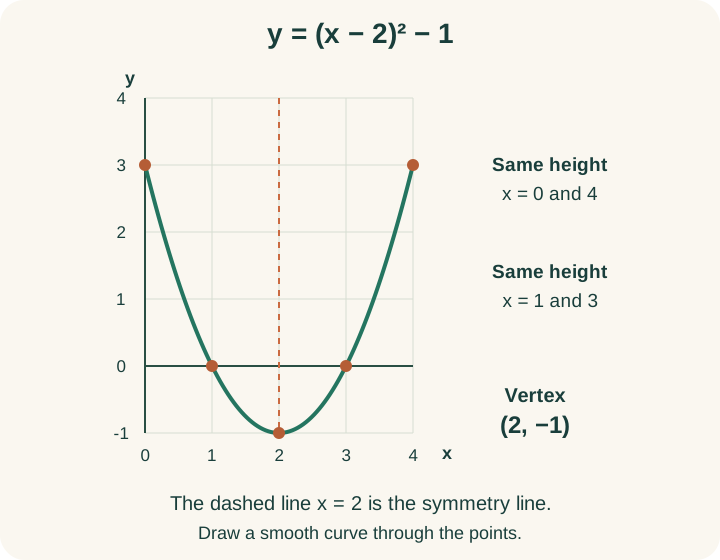
Mark the vertex, its vertical line of symmetry, and a few pairs of equally spaced points. For y = (x − 2)² − 1, the vertex is (2, −1); x = 1 and 3 both give y = 0, while x = 0 and 4 give y = 3. Draw a smooth curve through the symmetric points, not straight connecting segments.