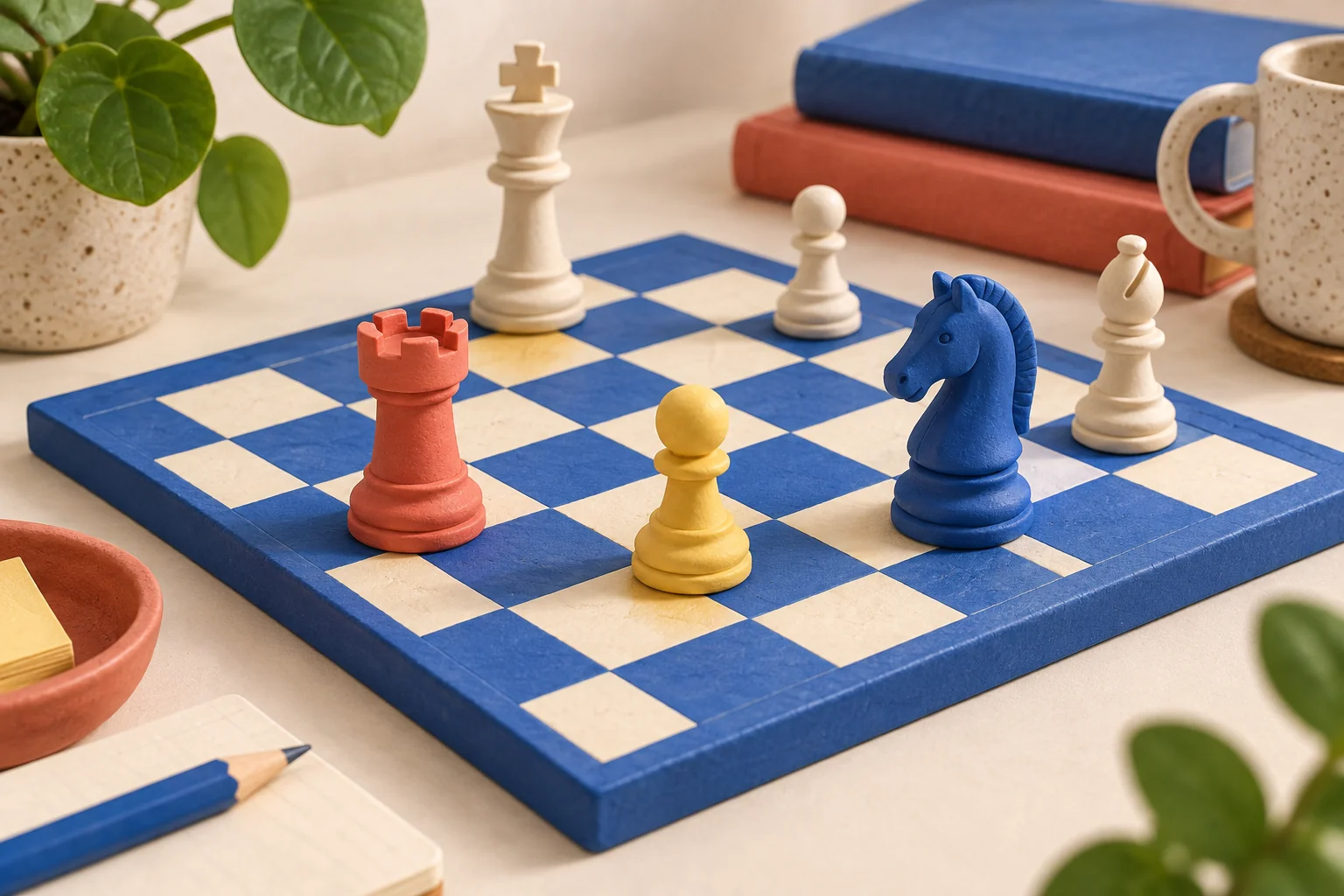
You do not need to memorize an opening to start learning chess. First learn where the pieces begin, how each moves, and why protecting the king matters. Play an unhurried practice game with a partner or a beginner board that shows legal moves.
Set up with a light square at your right-hand corner, learn each piece’s moves, and practice keeping your king out of check. Checkmate, not capturing the king, ends a win.
Go straight to the stepsBefore you begin
This is a first-session guide. Special moves and draw rules also matter; consult the linked full rules before treating it as a complete rulebook.
What you’ll need
- A chessboard and complete pieces, physical or digital
- A beginner partner or a board with legal-move hints
- Time to pause and discuss moves
Let’s do this
Step by step
- 01
Set up the board
Place a light square in your near-right corner. Viewed from White’s side, each back rank reads rook, knight, bishop, queen, king, bishop, knight, rook from left to right. Queens begin on their own color. Pawns fill the rank in front.
- 02
Practice one type of piece at a time
Use an otherwise empty board and the movement table below. Point to possible destinations before moving. Most pieces cannot jump over other pieces; the knight can.
- 03
Learn what check means
A king under attack is in check. Your move must remove that attack, and you may never leave or move your own king into check. If no legal reply removes check, it is checkmate.
- 04
Play slowly from the starting position
White moves first, then players alternate. Before each move, ask what your opponent attacks and what your move leaves unprotected. Use the rules when unsure rather than guessing.
- 05
Review one moment
After the game, choose one piece you lost without expecting it. Rebuild that position if possible. Find the attacking piece and describe its route. That one observation gives your next practice session a purpose.
Optional supplies on Amazon
Affiliate disclosure: As an Amazon Associate I earn from qualifying purchases. How our links work.
Use what you already have. These links open Amazon search results so you can compare suitable supplies; they are not individual product reviews.
Three special moves to learn next
Promotion replaces a pawn that reaches its last rank with a queen, rook, bishop, or knight of the same color. Castling combines a king move and a rook move under specific conditions. En passant is a special pawn capture available immediately after a qualifying two-square pawn move. Learn their exact conditions from the full rules before using them.
Checkmate and stalemate are different: stalemate occurs when the player to move has no legal move but is not in check, and the game is drawn. A king with no useful-looking move is not automatically checkmated; another legal move or a way to remove the attack may exist.
A first practice exercise
Place a lone rook near the middle of an empty board. Name its possible destinations, then put a friendly pawn in one of its paths and try again. Repeat with a bishop and knight. This suggested exercise isolates movement from the pressure of a full game; it is not itself a legal game position.
Basic moves at a glance
| Piece | Usual movement |
|---|---|
| Rook | Any clear distance horizontally or vertically |
| Bishop | Any clear distance diagonally |
| Queen | Any clear distance horizontally, vertically, or diagonally |
| Knight | An L: two squares one way, then one perpendicular; can jump |
| King | One square in any direction, avoiding attacked squares |
| Pawn | Forward one; optional two from its start if clear. Captures one diagonally forward. |
A quick final check
- The board orientation and queen positions are correct.
- I can explain check and checkmate.
- I consult full rules for special moves.
Common questions & sticking points
Should I learn openings first?
Start with legal moves and noticing attacks. An opening sequence is easier to understand once you know why a move is legal and what it protects.
Can I capture the king?
No. A game ends at checkmate rather than physically capturing a king.
Sources & further reading Optional
References used to check this guide. Follow your product’s own safety instructions where its design differs.
Last source check: September 21, 2026