The elastic edge makes a fitted sheet look like a problem with no straight lines. The trick is to use the corner seams as your reference points, then make a rectangle on a flat surface. A useful, stackable fold matters more than making it look perfectly flat on the first attempt.
Nest the four corners, place the sheet flat, tuck the elastic edges inward, and fold the resulting rectangle to fit your shelf.
Go straight to the stepsBefore you begin
Find the corner seams before starting. If the sheet is large, work on a bed rather than trying to hold the whole thing in the air.
What you’ll need
- A clean, fully dry fitted sheet
- A clear bed or table
Let’s do this
Step by step
- 01
Pair the first two corners
Find two adjacent corner pockets along the same edge, not diagonally opposite corners. Put a hand inside each pocket and bring their seam tips together. Turn one pocket over the other so both seams nest at the same point.
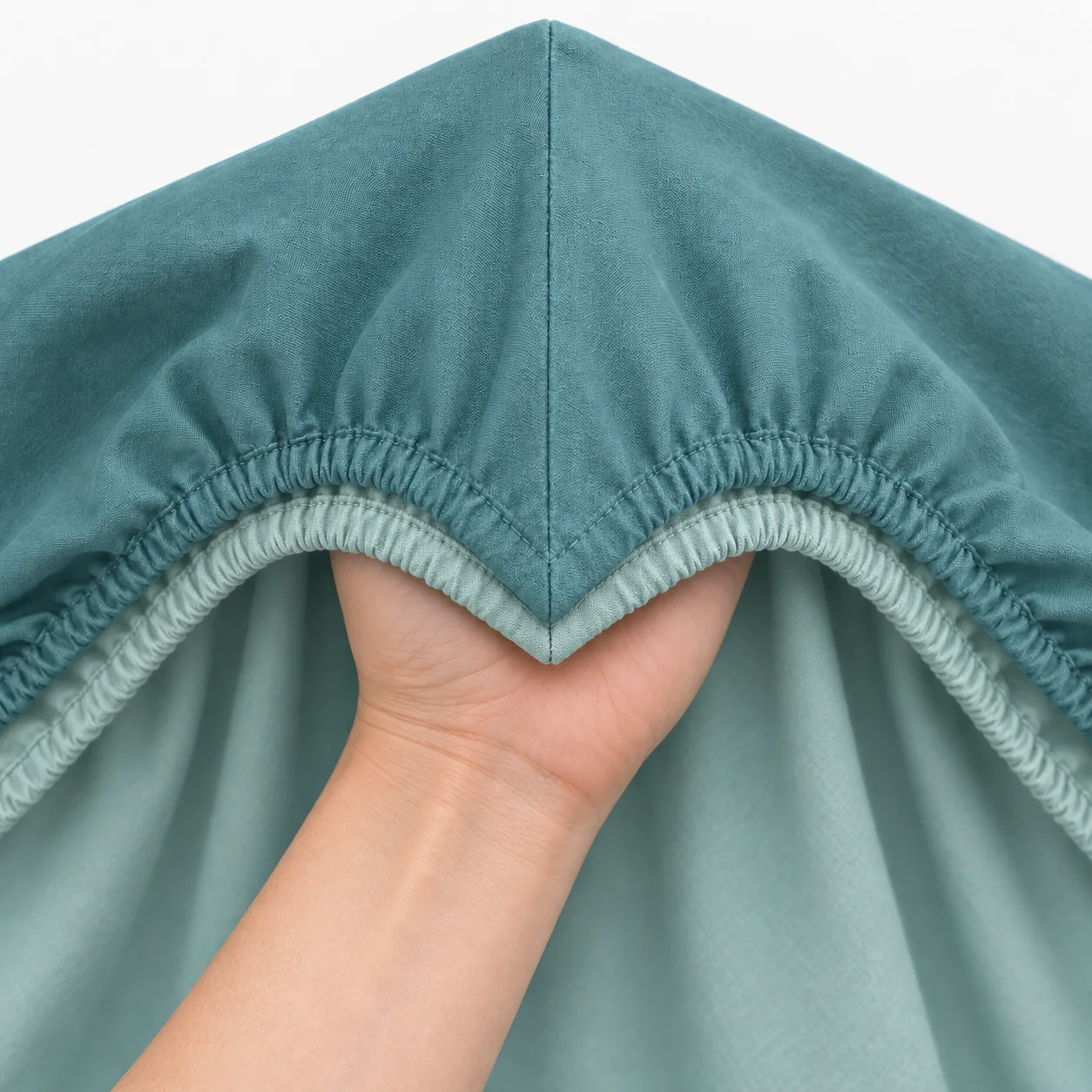
After nesting, the two corner seam tips meet. Follow the same edge to find adjacent corners.Open full-size image - 02
Pair the remaining corners
Keep the first pair together. Follow the elastic edge to find the other two corner seams and nest that pair. Bring the two pairs together, turning one pair over the other until all four seam tips share one corner. Set the bundle down if it twists.
- 03
Set the sheet down
Lay the nested sheet on a clear bed or table, keeping the corner group together. Pull the long flat edges straight with your hands. Fold the gathered elastic margins inward so the outside outline becomes a rectangle; the inside can stay a little uneven.
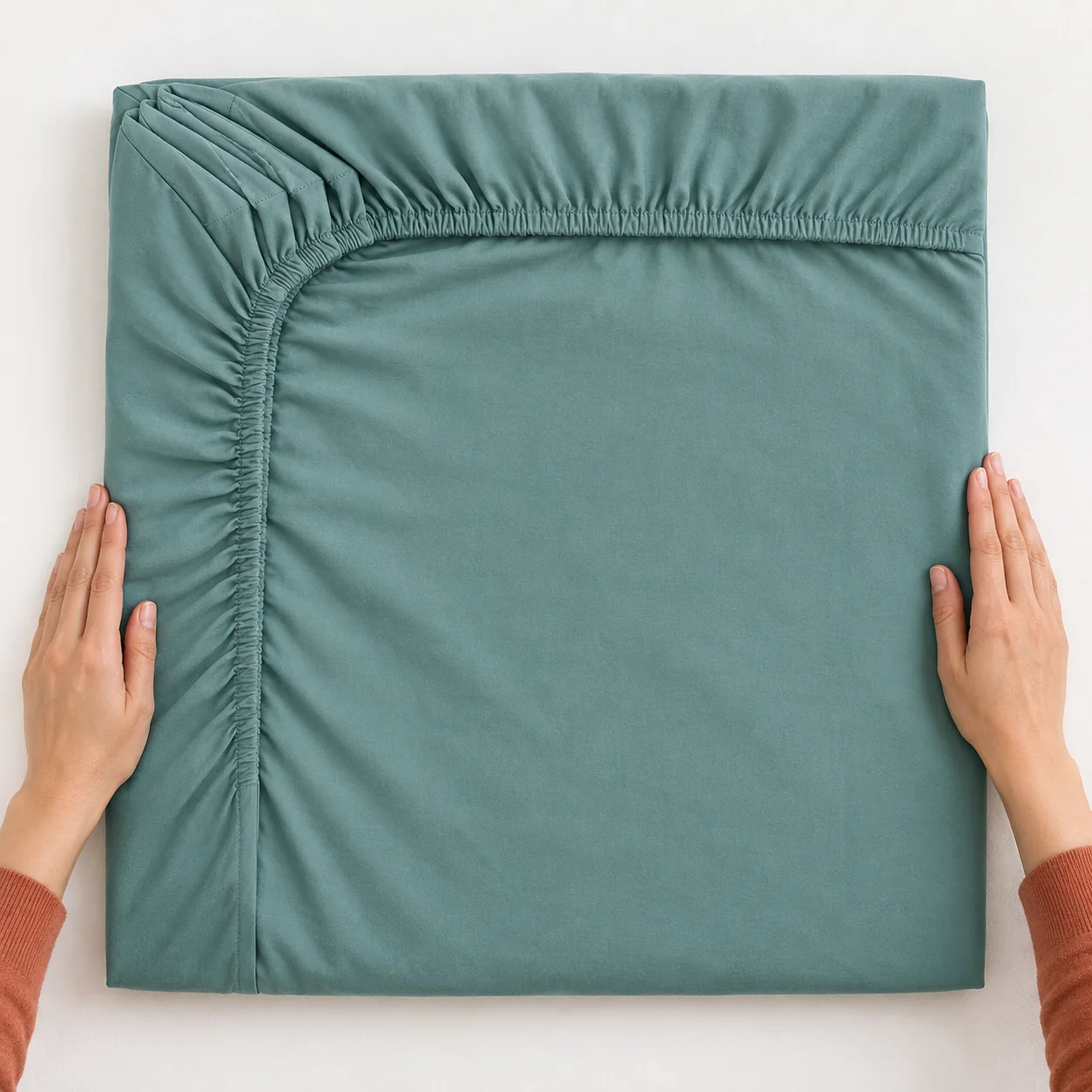
Keep the nested corners together and fold the elastic edges inward. A straight outer outline is enough.Open full-size image - 04
Fold to shelf width
Fold the long sides inward to make an even strip. Fold that strip into halves or thirds according to the depth of your shelf or drawer.
- 05
Stack and adjust
Turn the smooth side upward. If the bundle is too tall or too wide, change the final folds rather than starting the entire process again.
Use the corner seams as landmarks
If you lose track of the next corner, run your hand along the elastic until you reach a seam. Do not try to solve the whole bundle at once. Find the next seam, line it up with the others, and let the flat surface support the rest.
For your first practice, use a smaller fitted sheet if you have one. After the corners make sense, the same sequence applies to a larger sheet; you simply need more room to spread it out.
Store complete sets where you use them
Keep fitted sheets with their matching flat sheet and pillowcases, or label shelves by bed size. Choose the system that avoids opening several bundles to find one set. A consistent fold that fits the space is more useful than a beautiful fold that collapses whenever you remove a sheet.
A quick final check
- The sheet is completely dry.
- The corner seams are nested.
- The finished bundle fits its storage space.
Common questions & sticking points
Why is the sheet still a little lumpy?
Some bulk is normal around the elastic. If the whole sheet spirals, check that you paired adjacent corners rather than opposite ones. If only the edge is lumpy, tuck it inside the rectangle and smooth the broad fabric before the final folds.
Should I buy special organizers first?
Try the fold in the shelf or drawer you already use. Decide whether a divider would help after you know the bundle size.
Sources & further reading Optional
References used to check this guide. Follow your product’s own safety instructions where its design differs.
Last source check: September 22, 2026